
Returns: where fulfillment's real losses actually begin
When sellers compare fulfillment providers, the metric they look at most is outbound: shipping accuracy, cut-off times, unit rates. But the place where real losses quietly pile up in day-to-day operations is somewhere else entirely. It's returns.
Return waybills arrive from the courier every day and get lost while someone tries to log them by hand; an inspected item ends up nobody-knows-where and drifts out of sync with inventory; a shipper who wants to know a return's status has to ask the fulfillment provider one case at a time. That's the structure — and most 3PLs stop right there.
RUNIC built and runs its own in-house returns management system specifically to solve this. It isn't a third-party solution; it's a shipper-only platform built together by RUNIC's operations and in-house development teams, and it is provided free to shippers who work with RUNIC — custom modifications included, at no cost.
1. CJ return waybills, captured automatically at 100%
Every return waybill coming in from the courier is recorded in the system automatically. Operators never have to key waybills in by hand each day.
Why it matters: manual entry produces omissions. A single missed return becomes "an item that's in stock but can't be found," which turns into an outbound incident. RUNIC integrates external logistics data with the system so a waybill is recorded the moment it arrives, and automatically captured waybills are separately protected so no one can overwrite them by mistake.
2. Real-time return-waybill tracking — a rare differentiator in the industry
In RUNIC's returns system, status is updated automatically down to the individual return-waybill number.
Most fulfillment providers track only the outbound waybill and never handle the return waybill separately in their system. The usual setup is to identify a return by hand only after the box reaches the center, or to have the shipper check status by asking the fulfillment provider one case at a time. 99% of providers on the market stop here.
RUNIC is different.
- Return request → courier pickup → transit → RUNIC inbound → inspection → restock/disposal: the entire path is tracked automatically.
- When a shipper searches by original waybill or return-waybill number, they get step-by-step tracking on par with an outbound waybill — even knowing just the original waybill, the system automatically tracks the matched return waybill and shows it alongside.
- Status changes are updated automatically by the system, so shippers can see the latest status without refreshing anything themselves.
Impact on customer support: it goes beyond a simple status check and becomes an operational asset.
- A consumer asks, "Did my return arrive okay?" → the shipper looks up the return waybill in the system → an immediate answer on whether it's in pickup, in transit, or under inspection after arrival.
- Product condition and the customer-support history are logged per waybill, so when the same waybill is looked up again later, the full context of the earlier response is right there — even a repeat inquiry on the same case never has to start over from scratch.
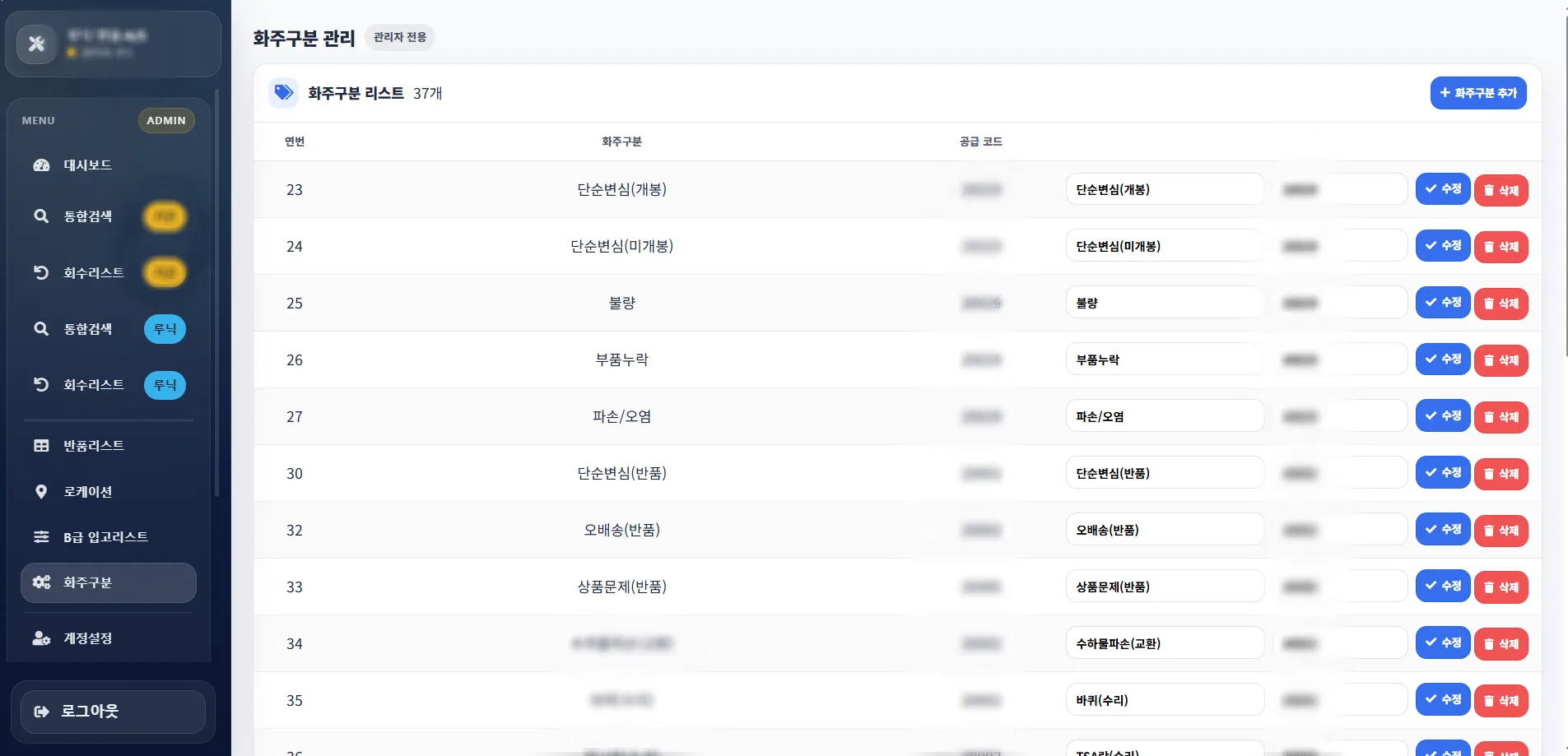
- Returns can be managed separately by reason. For example, gather only change-of-mind returns and branch the flow into resale after quality inspection, B-grade handling, or re-shipment to lower the disposal rate and raise the inventory recovery rate.
- Shippers can run this directly without asking the fulfillment provider, so both response speed and operational autonomy go up.
3. Original-waybill scan matching — counted as inbound only when it actually arrives
A return being registered in the system doesn't mean inbound is done. RUNIC adds a separate matching-verification step at the moment the item physically arrives at the center.
- When a return box arrives, the worker scans the original waybill (the outbound waybill) attached to the item.
- The system automatically matches that original waybill number against the registered return-waybill data.
- Only when the match is confirmed is it registered as actual inbound and reflected in inventory.
Why this matters:
- When a wrong return gets mixed in (another seller's item, a different waybill, a missing label, and so on), the system blocks it on the spot.
- It prevents the "return waybill was registered but the goods never arrived" no-show incident — a common problem in systems that rely on manual inspection alone.
- Bidirectional matching of outbound waybill ↔ return waybill is logged, so it can be traced if a dispute arises later.
Fulfillment operations that rely on manual inspection alone lack this step, so it's common for them to process a wrong return straight through as inbound. At RUNIC, inbound is recognized only after the system has verified it automatically.
4. Automatic per-item location tracking — know where it is, instantly
More important than the fact that a return has come in is "where that item is right now." A typical fulfillment system processes only up to inbound registration and leaves the storage location to a worker's memory or a note. Over time you get "the item exists but nobody knows where," and inventory drifts out of sync.
RUNIC's returns system records the storage location automatically at the same time as inbound verification.
- Once original-waybill scan matching is complete, the inspection team scans the storage location (rack, zone, box number) and it is mapped automatically in the system.
- When a shipper or operator searches by waybill number, product name, or SKU, the current storage location is shown right there.
- Even when items are stored in different zones by status — good, B-grade, awaiting disposal — the system tracks all of them.
How it's used on the floor:
- When a client claim requires re-inspecting a specific item → look up the location in the system → what used to take tens of minutes now takes tens of seconds.
- When scheduling quality-inspection work → optimize the work path by location.
- During a physical inventory count → compare the system location against the actual location to flag mismatches immediately.
- For disposal → batch-process the items gathered in the disposal-hold zone.
If "the return came in but we don't know where it is" is the reality at ordinary fulfillment providers, at RUNIC return inbound and location tracking run as one flow.
5. Multiple intake paths, unified — no more copying things down by hand
We offer five return-registration paths tailored to the operational floor.
- Automatic capture — waybills registered automatically via external logistics-data integration.
- Handoff from WMS customer-support recovery intake — the "recovery in progress" list registered by the CS team in RUNIC's WMS is selected item by item and handed off to the returns system with the data intact. CS and the returns team work on the same data, so there's no double entry.
- Unified search intake — find the original order by recipient name, order number, or waybill number, display it split into line items (by product), then multi-select and register in bulk.
- Excel upload — bulk registration.
- Barcode scan — register right there on the inbound floor.
Even when a single order contains several products, each product is displayed as its own separate card, so precise management is possible — within the same order, product A goes to return processing while product B is left as is. Anything already registered automatically shows a "Registered" flag to prevent duplicate registration.
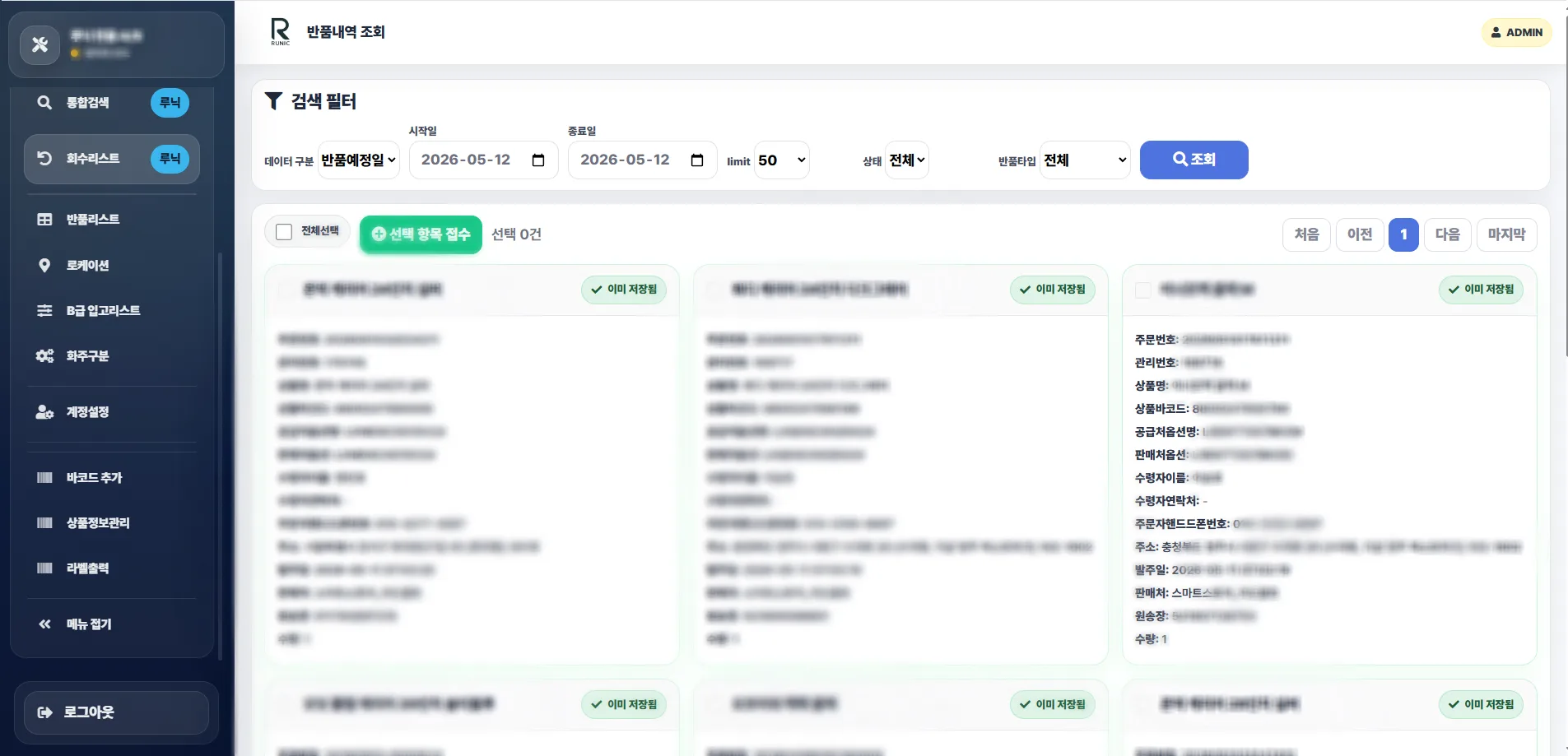
6. Real-time return-status checks — customer support gets faster
Alongside return-waybill tracking, every processing step after inbound is also exposed to the shipper in real time.
How it's used on the customer-support floor:
- A consumer asks, "I sent a return yesterday — has it been processed?" → open the system once, search the waybill → immediately see the stage, from in pickup to inbound to inspection complete to restock → answer on the spot.
- A claim that the return arrived but the refund is late → check in real time whether it's at the inspection or restock stage → even give the exact expected processing date.
- A B2B client asks to confirm return quantities → because status is displayed separately at the line-item level, you can give a granular answer — product A restock complete, product B disposed.
Where the old customer-support answer was "let me check and get back to you," with RUNIC's returns system the answer comes right there and then. As response time drops, customer satisfaction and repurchase rates rise.
7. Returns data, turned into analytics — you can see "why returns happen"
RUNIC's returns system isn't just a tool for recording waybills. It automatically turns accumulated returns data into analytics, delivering insight the shipper can use to improve future operations.
Examples of the analytics the system shows:
- Return rate by product / SKU — which products generate the most returns.
- Return-reason distribution — which reasons dominate: change of mind, defect, mis-shipment, size mismatch, and so on.
- Return trend over time — whether returns cluster right after a particular season, promotion, or event.
- Restock / disposal / B-grade ratios — of the returns recovered, what share is resalable.
- Return rate by client / channel — which channel generates more returns.
Improvement points the shipper gains:
- A specific SKU has an abnormally high return rate → reinforce the detail-page copy, photos, and size information.
- Many returns cite size → revamp the size guide or improve option accuracy.
- Returns cluster on a specific channel → review that channel's exposure content and customer support.
- A seasonal return-rate pattern emerges → adjust next season's order volume and inventory operations.
- A category with a high disposal rate is found → reexamine packaging and shipping methods.
Returns aren't merely an operational burden; they're data you can use to improve product planning and sales strategy. RUNIC's system aggregates that data automatically so shippers can query it themselves — no need to file a separate request with the fulfillment provider to receive it.
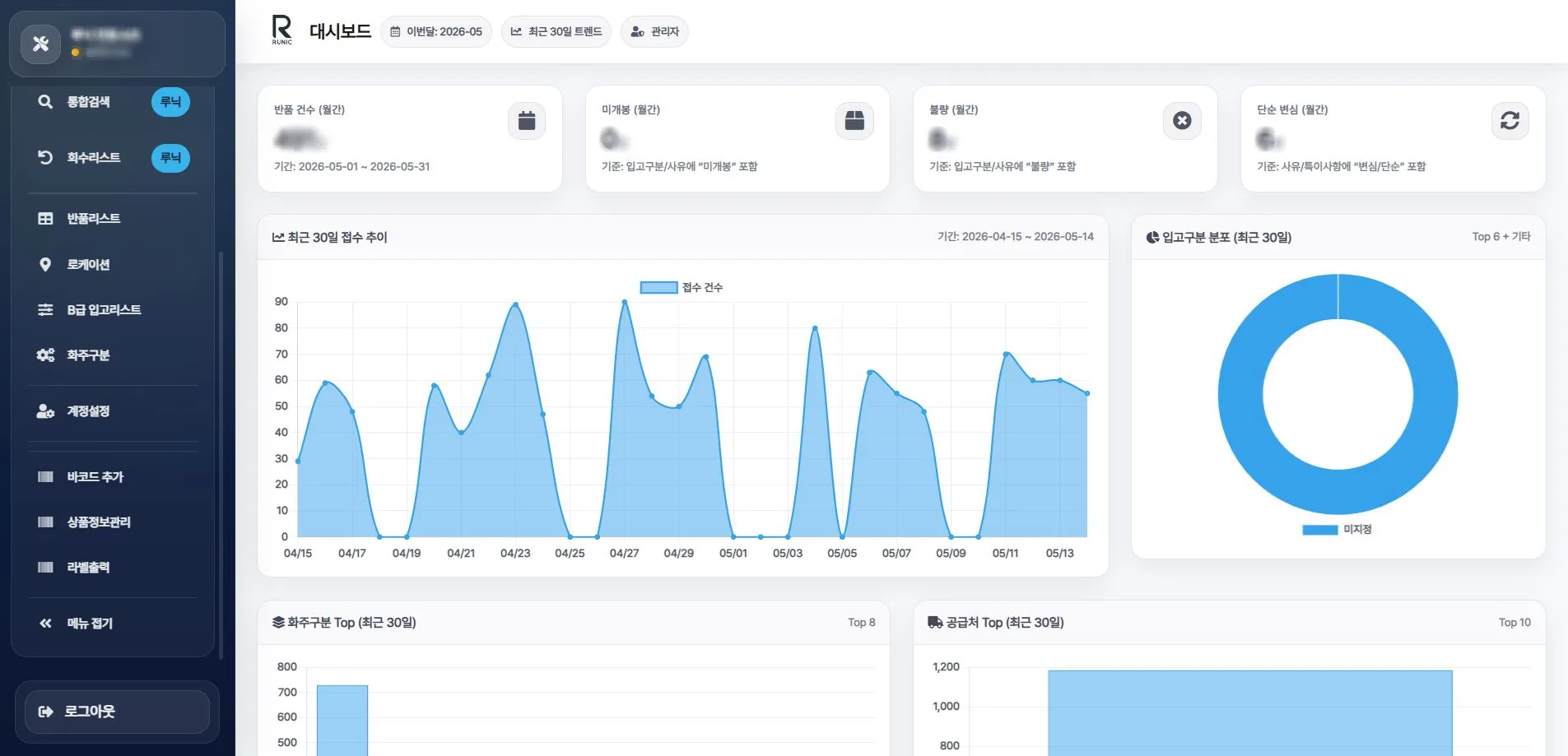
8. The system blocks "unintended value changes"
There's an incident common across the industry — when a form is saved, a field the user never touched quietly flips to its first option and corrupts the data. RUNIC's system tracks whether the user actually touched a field, so any field left untouched keeps its existing value.
What this means: even if an operator was working in a different cell and hits Save by accident, no other field gets corrupted. Data integrity is guaranteed at the system level.
9. One tap to receive, one tap to label
Once inspection is done, a single Receive tap records the inbound timestamp automatically. For items that need a label, a single Print Label tap prints the barcode, control number, and product name. Output is a label-printer-verified PDF that prints directly with no separate conversion.
10. Large data sets, handled safely
When you export tens of thousands of return records to Excel, the system builds the file in the background while showing progress in a live modal (total count / completed count / percentage / elapsed time / time remaining). You can keep working on other tasks while you wait for the download.
11. Shippers see it directly — only their own data
Access is separated, so a shipper can view only their own company's data, the inspection team can edit only the inbound timestamp, and only administrators see the full operational data. A multi-tenant structure keeps shippers' data from mixing.
What shippers get
- Use all of the above features free of charge — no solution license fee, no per-account billing.
- Custom modifications, also free and applied quickly.
- Check directly on return progress without asking the fulfillment provider.
- Track the full path in real time by return-waybill number — recovery → transit → inbound → inspection → restock.
- Instantly look up the storage location (rack, zone, box) of an inbound return item by waybill or SKU.
- Give consumers and clients immediate answers on customer-support inquiries — shorter response time, higher repurchase rates.
- Surface improvement points by product, channel, and season from accumulated returns data.
- Head off inventory mismatches caused by quantity or waybill errors.
- Boost operational speed by splitting CS handling and return inbound to run in parallel.
- Query return rate, restock rate, and disposal rate by SKU directly.
Provided free to shippers — custom modifications included, at no cost
RUNIC's returns management system is provided free to shippers who work with RUNIC. There's no separate solution license fee and no per-account billing. Any shipper who entrusts their returns operations to RUNIC uses every feature described above — automatic waybill capture, return-waybill tracking, original-waybill matching, location tracking, analytics — exactly as is, at no additional cost.
What matters more is that custom modifications are also free. With a third-party solution, changing even a single screen means getting a separate quote from the vendor and paying development fees. RUNIC is different.
- Custom development, also free — shipper requests such as a specific channel integration, a client-specific label format, a reason-classification scheme, a special inspection flow, or additional analytics fields are implemented at no extra cost.
- Fast turnaround — because our in-house development team runs it directly, request → review → development → deployment all happens within one team. There's no outside contracting, quoting, or contracting stage, so there's no waiting weeks or months.
- With the operations and development teams inside the same company, floor feedback is reflected in the system right away.
- By the same approach, our own WMS and TMS are also developed and operated in-house at RUNIC — returns and the other operational tools connect as one flow.
When a shipper asks, "Could you change this to work like this?", RUNIC can say, "We'll review it, build it, and deploy it for you — at no cost." That's a hard answer to give at a fulfillment provider running a third-party solution.
It's possible precisely because the company that runs the operations built it itself. RUNIC knows the on-the-ground reality that every shipper operates differently, every client's label format differs, and every inbound-inspection standard differs. So instead of buying a system from outside, we built it ourselves — and we share that system with shippers, free.
Official website www.runic.kr · B2B delivery outbound inspection · SLA checklist · SmartStore fulfillment guide →