
How to Eliminate Mis-Shipments in B2B Order Fulfillment
Most fulfillment conversations focus on B2C seller shipping. On the warehouse floor, however, B2B trade-partner deliveries that go straight to a business customer carry far more weight, because a single mis-shipment triggers a very different fallout. Here RUNIC shares the root causes of B2B mis-shipments identified across our Gimpo center operations, and how our in-house verification system reduces them.
1. Why a mis-shipment hurts far more in B2B deliveries
When a mis-shipment happens in B2C (seller → individual consumer), it can usually be recovered with a refund or exchange. The worst damage is typically a dinged channel rating. B2B shipping (seller → trade partner / wholesaler / brick-and-mortar store) is a different matter.
- Trade-partner trust breaks down. Once an error surfaces at their inbound inspection, follow-up orders shrink or dry up.
- Recovery and re-shipping costs are steep. Retrieving goods shipped wrong by the box and re-sending them costs far more than a single B2C return.
- Delivery penalties apply. For large retailers and merchandiser (MD) purchase orders, contracts often spell out explicit penalty clauses for late delivery.
- Tax-invoice and settlement flows get tangled. When shipped quantity and tax-invoice quantity don't match, the impact reaches all the way into accounting and settlement.
If 99% accuracy is enough for B2C, then 99.9% or higher is effectively the baseline for B2B.
2. Five errors that occur most often in B2B shipping
These are the mis-shipment patterns we encounter most on the floor. Knowing where they occur shows you where to stop them.
- Crossed waybills: Trade partner A's waybill ends up on trade partner B's box and ships out. The most common failure, and the most damaging.
- Quantity errors: In box-unit shipping (e.g., 12 units × 5 boxes = 60 units), the box count is off, or the quantity inside a box is wrong.
- Item mix-ups: Within one trade partner's order, product B slips into product A's box. Common in categories with many similar SKUs and variants.
- Missing labels or markings: An order ships without the extra labels the trade partner requires (country of origin, barcode, PO-number labels, and the like).
- Packaging-unit misses: A product that should ship as individual units ships by the box, or a product that should ship by the box ships as loose units.
They share one thing: these are errors that visual inspection alone cannot catch. The system has to add another layer of defense.
3. RUNIC's verification system — how we reduce mis-shipments
RUNIC runs B2C and B2B on the same standard. Trade-partner deliveries pass through the exact same verification gate as seller shipments, and every shipment is processed on our in-house B2B shipping management system.
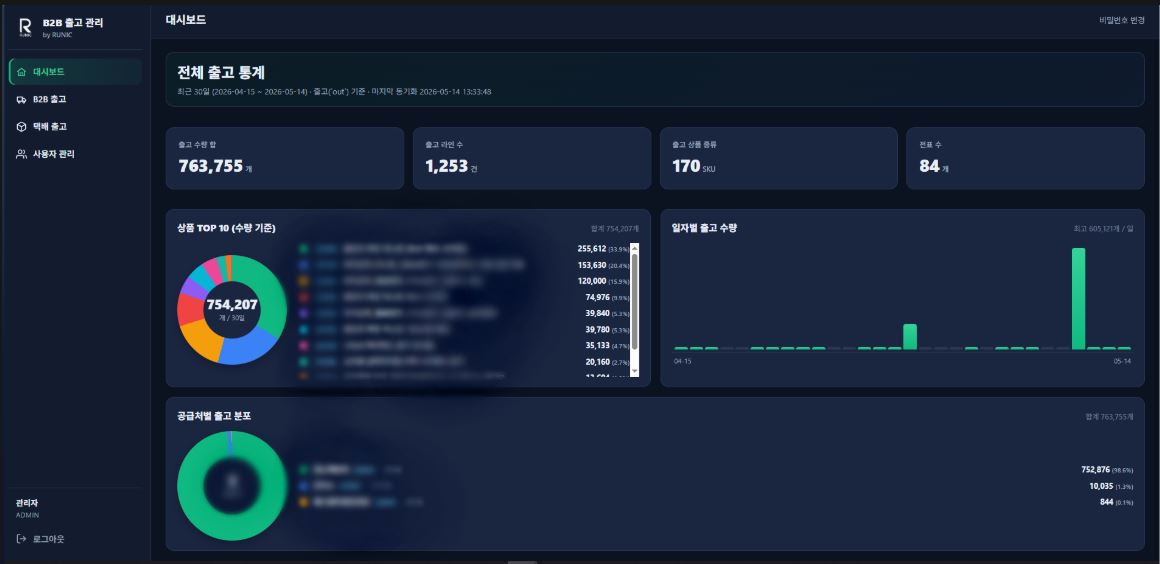
Every SKU barcoded — no exception for B2B
Every product received at the RUNIC center is assigned a barcode at the SKU level. We assign separate barcodes even to B2B-only shipping boxes and trade-partner bundle units, so the system performs a first-pass check. That differs from fulfillment providers that barcode only B2C SKUs and handle B2B shipping by hand.
In-house verification software — 1:1 matching of waybill and product
Instead of an outside solution, RUNIC uses verification software we built in-house. At the packing stage, when a worker scans the trade partner's waybill, the system displays the product barcodes that must be tied to that waybill. The worker scans each product one at a time, and the box can only be sealed once 1:1 matching is complete. Crossed waybills, item mix-ups, and quantity errors are blocked at the system level.
Verification starts with automatic collection of slips (transaction statements). Specify a date range and the shipping slips sync into the system automatically; each slip is counted by SKU and quantity, and verification progress is displayed in real time. Operators never have to key in slips one by one.
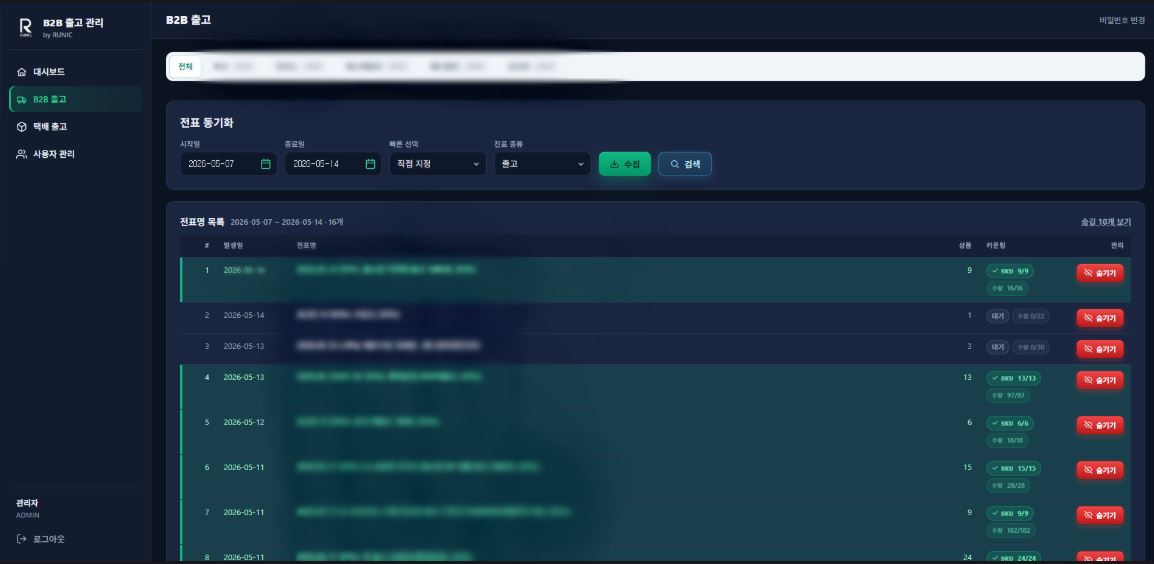
Vehicle-loading verification — real-time count against required quantity, with separated permissions
For trade-partner vehicle deliveries, every time a worker scans a barcode the count rises in real time against the required quantity, and each SKU's status (pending / complete) is shown on screen. Because it only completes once every required quantity is met, quantity errors are caught at the verification stage.
What matters is separated permissions. Quantity adjustments (+/-) and count resets are available only with administrator rights; a regular worker can only scan and cannot alter the numbers at will. This shuts off, at the source, the kind of tampering where someone forces the count to match on the floor.
In addition, every menu's verification action gives the worker instant feedback through voice prompts and visual effects. Scan success or failure, quantity completion, and errors register through sound and color changes, so the worker doesn't have to keep staring at the screen — and floor verification gains both speed and accuracy.
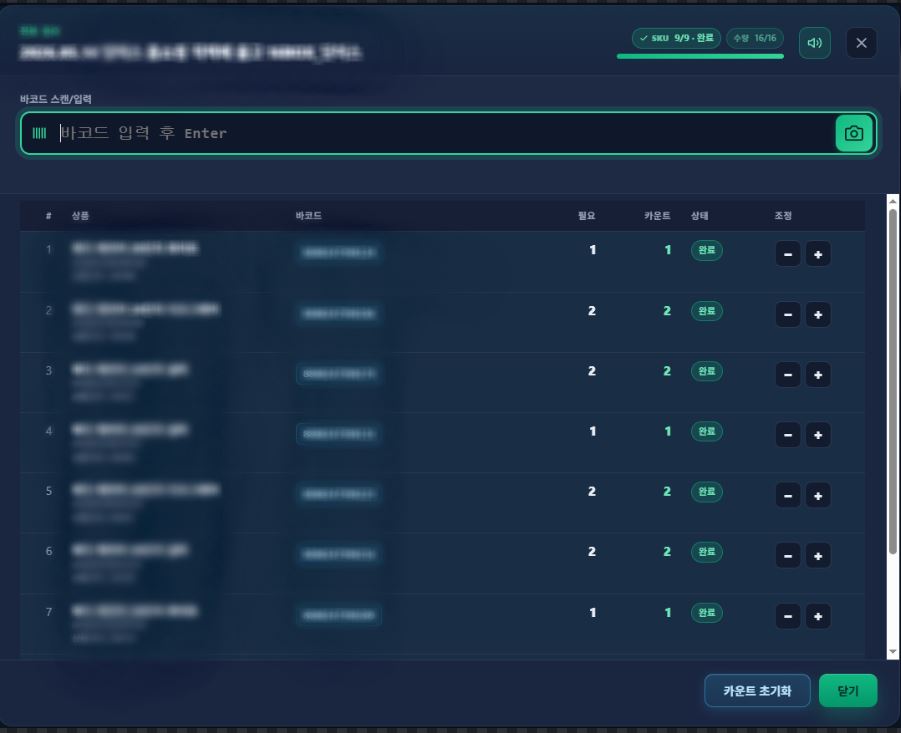
Home-shopping and bulk parcel shipping — B2B-type parcel orders are verified and tracked too
Beyond pure trade-partner deliveries (B2B), the same verification standard applies to orders that are B2B in nature yet ship to individual consumers by parcel, such as home-shopping purchase orders. Unlike ordinary B2C parcels that just print a waybill and go out as-is, RUNIC in this case too verifies the parcel tracking number and the product barcode 1:1 before shipping, and after shipping continues with delivery tracking per waybill.
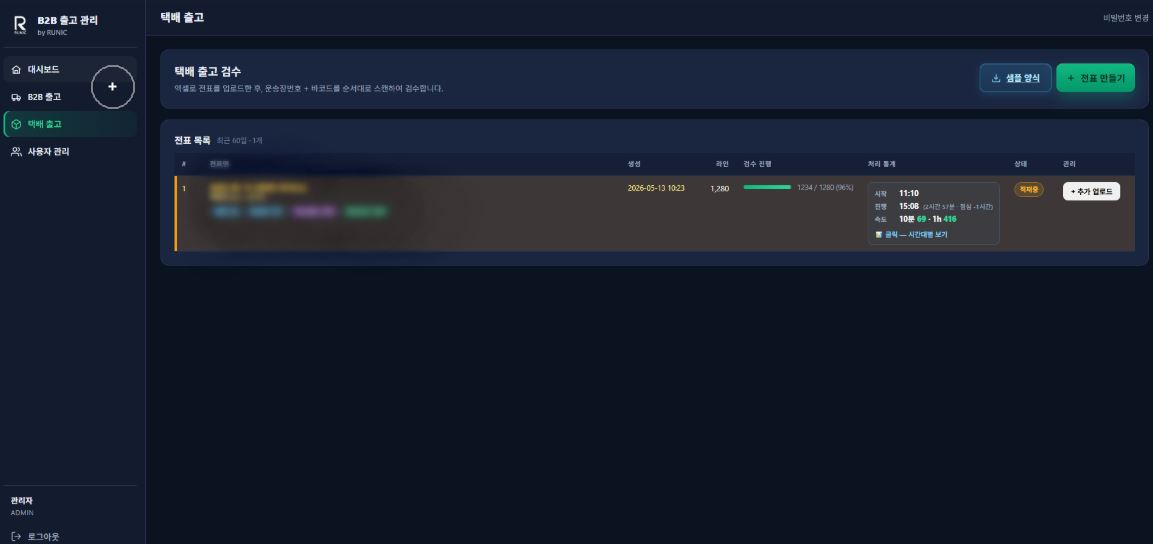
On the verification screen, you scan in the order ① tracking number → ② product barcode. A line only completes once the product that belongs to that waybill is scanned correctly, so even in high-volume home-shopping orders, nothing ships with waybill and product mismatched.
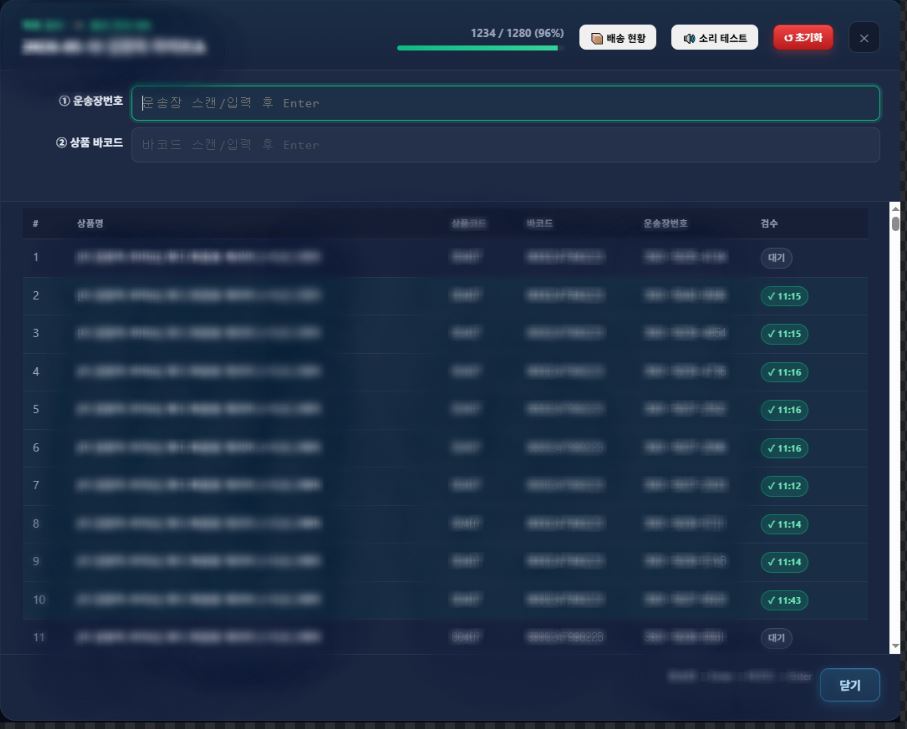
The more an order concentrates a large volume into a short window — home shopping, group buys, large-scale promotions — the greater the ripple from a single mis-shipment. Even when volume surges, the verification gate is never skipped, and tracking of which waybill went where, and by when, never breaks.
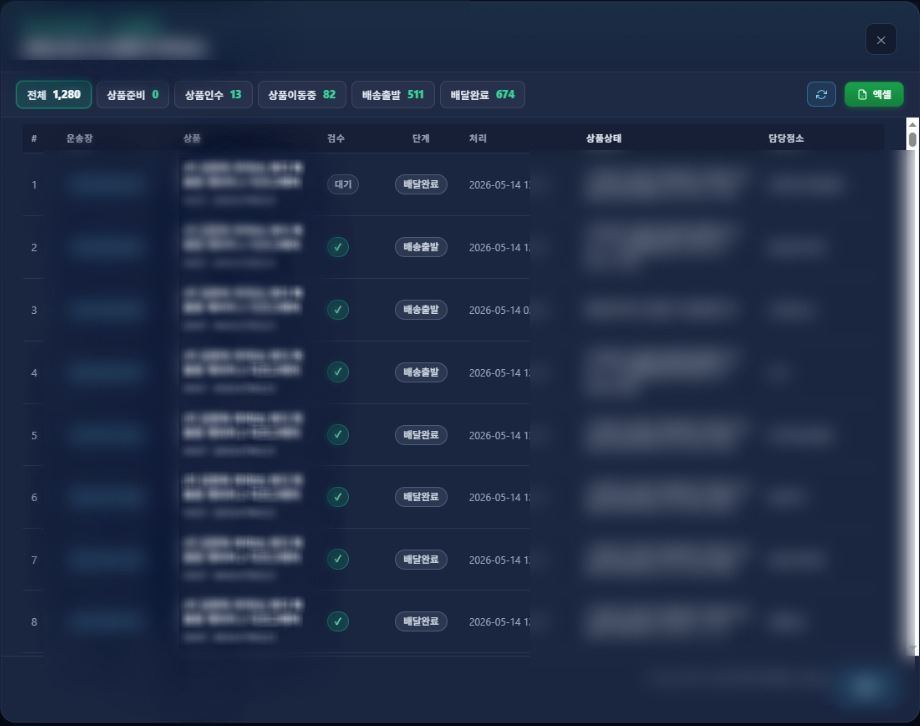
After shipping, a delivery-lookup screen linked to carrier tracking aggregates each waybill's stage (order preparation, pickup, in transit, out for delivery, delivered) in real time. Because the count at each stage against the total is visible at a glance, you can immediately single out missing or delayed shipments.
Two-stage verification gate — picking scan + packing re-check
A product that clears the first gate with a barcode scan at the picking stage still goes through waybill-to-product matching verification once more at the packing stage. If a mismatch occurs at either gate, that box is pulled from the shipping line. It raises the probability of blocking a mis-shipment dramatically over single-stage verification.
4. Checkpoints to confirm when choosing a fulfillment provider
If B2B shipping sits at the center of your operation, be sure to confirm the following four points when choosing a fulfillment provider.
- SKU barcode standard: Can they barcode not just B2C SKUs but also B2B box and bundle units?
- Waybill-to-product matching verification: Do they have a system that matches waybill scan and product scan 1:1?
- Number of verification stages: Single stage, or two-stage picking and packing verification?
- Dashboard visibility: Can the shipper directly look up shipping accuracy and mis-shipment causes by trade partner?
If all four are in place, it's a fulfillment provider you can hand your B2B operation to with confidence. Detailed SLA comparison criteria are available in the SLA checklist for choosing a 3PL provider.
The RUNIC standard
RUNIC operates B2C, B2B, and home-shopping-type parcel shipping all on the same verification standard, from an approximately 3,000-pyeong fulfillment center on the 4th floor of K-One Gimpo Logis. We hold shipping accuracy at a 99.9% standard: whether it's a trade-partner delivery or a B2B-type parcel order, boxes are sealed only once waybill-to-product 1:1 matching is complete on our in-house WMS and verification software, and shipping continues into per-waybill delivery tracking.
Official website www.runic.kr · SLA checklist · 3PL cost structure · SmartStore fulfillment guide →